- 15
- 3
- 2
- 9
- 12
- 2
- 1
- 9
- 1
- 7
- 12
- 3
Call / WhatsApp: Ahmedabad Office: +91 9033109309, 9725477947 | Baroda Office: +91 7600233132

Select Page
Modhera Sun Temple
About the Location
As one traverses the length and breadth of Gujarat, one continually encounters the architectural legacies of the Solanki rule. These living spaces and monuments from another era offer an eclectic glimpse of the artistic and ingenious beauty that makes this vibrant state so exotic.
A soothing drive amidst green farmlands, almost 25 km from Mehsana on the way to the temples of goddess Bahucharaji, leads to the village of Modhera. Set against the backdrop of the River Pushpavati, surrounded by a terra-formed garden of flowering trees and the songs of birds, rests the famed Sun Temple of Modhera.
The remains of the Sun Temples at Modhera, dedicated to the sun god, are relics from a time when reverence for the natural elements—fire, air, earth, water, and sky—was at its peak, sharing space with myriad manifestations of Vedic gods. The ancient philosophy venerating natural elements and their association with humans was considered the prime force and energy of the life cycle. A walk around the serene temple campus makes one aware of the positively strong aura of energy the place radiates, bringing visitors closer to the environment.
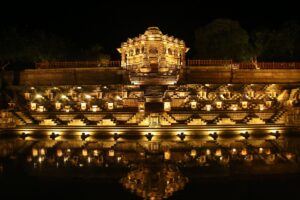
Enhancing the beauty of this already famous Modhera Sun Temple, in October 2022, Honorable Prime Minister Shri Narendrabhai Modi inaugurated a solar-powered 3-D Projection Mapping Show and Heritage Lighting at the temple. This unique experience adds another feather in the cap of this well-known temple.
Brief History
According to the Archaeological Survey of India, the Modhera Sun Temple was built in 1026-27 CE during the reign of Bhima I of the Chaulukya dynasty. As you enter the historical complex, you first encounter the magnificent Suryakund, a rectangular stepped tank containing 108 shrines dedicated to various gods and demi-gods. Notable among these are three main shrines positioned on three sides of the kund, dedicated to Ganesh, Vishnu, and an image of Lord Shiva performing the ‘tandav’.
Ascending the steps to the Sabha Mandap, or assembly hall, one is greeted with sculpted renderings of the twelve Adityas (another name for the sun god). The twelve representations carved on the pillars symbolize the sun through the twelve months.
After experiencing the Sabha Mandap, a visit to the Garbhagriha, the innermost sanctum, offers a profound spiritual experience. Although the statue of the sun god no longer exists and the Suryavanshi Solankis have faded into history, on the day of the equinox, one can almost hear the chanting of prayers, smell the aroma of incense, and hear the tinkling of bells as the sharp, linear rays of the sun illuminate the inner core of life and light.